Saturday, February 12, 2022

Please Stand By...

I have split off my research on all things Erving to a new blog called Erving's Past. I'll be back here with more stories about our family or other topics that catch my interest. Until then, please see what I have been researching here.

Wednesday, December 30, 2020

Good Bye to 2020


And so, the weeks turned into months and the year drew to a close, and a vaccine arrived on the scene...

No, blogging has not been my top priority during the pandemic. It seemed like there was lots of time to get things done. I did some of the writing I had intended to do, but it is a slow process. I presented a good group of genealogy topics virtually to several societies. Another handful got cancelled and the impetus to finish the research went with them. There were a few small engineering projects, but when the opportunity to go back to Saipan with FEMA came around, it seemed like the right thing to do. 

Being on a remote island during a pandemic has brought back my sense of well-being. The government restrictions have made this a relatively comfortable place to be. Masks are universally worn. Restaurants and churches take temperatures, and names and phone numbers for contact tracing. Everyone quarantines for 5 days in a designated hotel upon arrival, and doesn't join the general population without a negative screening test. As a result, we passed the 100-case milestone only a few weeks ago, with the majority of those caught at the airport. Nearly as important as the safety is the social contact available working with other people every day. Sure, being alone for most of six months wasn't as hard on me as it was on some people, but it feels good to banter with co-workers. And living on the 8th floor of a beach-front apartment is pretty sweet. Now, Zoom is working in reverse as I keep in touch with friends on the mainland. 

Feeling grateful, and a little guilty. And hopeful.


Sunday, May 3, 2020

May Day


What has happened in a month? We remain apart. There are more masks in use, in fact, the Governor of Massachusetts has required them in public places. School will not come back in session this spring. The deaths continue at an alarming pace, though slower in some of the cities like New York than they were a month ago. Deaths in nursing homes and Veterans' homes are shocking, and nearly 50% of the total locally. The Governors continue to show leadership that isn't coming from DC. The practice of the Feds. stealing (appropriating?) protective equipment from the states isn't making it easy for them.

I know of people who have recovered. I know of people who have died, primarily the elderly. There are protesters, even here in Northampton, who use their rage to put their own needs above others'. It is so wrong. We have to look out for each other.

Carolyn is able to sit on her beach in NC, as long as people do not crowd together. She continues to work from home and do virtual therapy. Brian converses with his students online as well. Jamie is at the end of his 2 week quarantine in a motel in Juneau, and will rotate to the island to the mine for the next two weeks. Alaska has fared pretty well so far, as have many less-populated areas.

The Senate is going back to DC, but the House, with four times the population, is not. It looks like the unemployment program for self-employed individuals applies to me. I have several projects on hold in Whately, Northampton, Greenfield, and Amherst.

This weekend the sun came back and the windows were open for 2 days. Cooler temps are predicted next week. Some days are more productive than others. I miss company, but we video conference, telephone, sit in our cars to eat together apart. I can't fathom what it is like for extroverts.

Saturday, April 4, 2020

Another Week Gone


How is that "writing every day" thing working out?

The COVID 19 virus is looming on the horizon. We have gone from people in nursing homes getting sick, to deaths of musical figures (also elderly), to one degree of separation with people posting about their relatives of any age in hospitals. It is going to get worse.

I accomplished quite a bit in the past few days. I reorganized the yarn stash and got it out of my room. I made moves toward organizing the spare room and Carolyn's room by getting a few unnecessary things into the trash. I went through a very old pile of fabric and sewing history, and spent Wednesday making fabric masks for the family. I still have scraps from the balloons I made for Jamie's infant room, his Halloween costumes, two skirts that were cut out and never sewn. I was happy to find some non-woven interfacing to line the masks and bias tape for straps. It was a whole day coaxing the old black singer to do more or less what I wanted it to do, but it is done. Two went to Alaska and two to NC. Brian says he won't wear it, but he got one too.


I video-conferenced with friends, family, and a committee in Sunderland. Looks like I will be doing more sidewalk design. I also recorded my Historic Maps talk for the MGC conference this weekend, and presented the same talk live via Zoom for WMGS. Last weekend I had planned on presenting at the Eastham Library (cancelled) and meeting with PGSMA Tuesday (also cancelled). The grand opening of our library was cancelled.

Except for a short trip to the grocery store, I didn't go out for food. There are still lots of options for take-out. I spent one entire day in a book. That hasn't happened in a while.

FEMA put out a call for workers via Dewberry. I did not check the box for working anywhere in a suit and mask. We will see if they have any at-home work to offer.

I feel very blessed to have three kids still on the payroll. None of them have to go out to work. I don't have to go out either. The cats are good company. I'm eating my own cooking. Except for milk, I could go a long time without needing more food, if I had to. On we go.

Friday, March 27, 2020

TGIF


Sunny days make all the difference. It would feel much different if we were going into winter in isolation. I can only pray that in six months we won't be having a resurgence.

I had an actual business meeting yesterday with the South Deerfield Fire Dept. to plan for repaving their parking lot. No hand-shaking. I went out today to get a burrito at Mesa Verde. Supporting local restaurants is something I can do. Hand sanitizer is prominent on the counter

My contract with the City of Northampton for doing their paving inspection this summer has no start date yet, but I got a message today just to say that everything is uncertain.

Another small job in Whately is pending "when the Town can conduct business again."

I recorded a webinar this morning about historic maps for the Mass. Gen. Council, whose April conference will now be virtual. Paid work!

So many people don't have savings. It feels strange to draw on my retirement account (how did we become "the elderly?"), but good to have savings. Not to panic. My kids are secure for now. All are still on the payroll. The funding bill passed the Congress.

Every day we hear about the heroic actions of hospital workers who don't have the equipment they need to help the suffering and to protect themselves. Being at home, making my own schedule most of the time is my usual state of being. My life hasn't changed so much, but I am thankful for my choices to life a rural life. The space between me and crowds of people. We start to know that every morning we wake up and face the fear. It is a lot like the feeling of unease that started in November of 2016 when knew it would be a long time until things were put right.

Tuesday, March 24, 2020


A little writing, a little knitting, too much TV. I was going to wait out the warmer temperatures expected and not deal with the snow, but I decided to go out and get a sandwich so I had to push it off the windshield. Supporting local business - the Black Cow Burger joint. I pulled a few articles about the 1918 flu pandemic from old newspapers. So many obituaries. I think that's where I'm at, less fear for now than dread about what's to come. Greenfield Savings bank announced an interest holiday for mortgages. I will have to follow that up.

Carolyn started conducting speech therapy by video screen. I'm glad that keeps her employed. She says her father took a warehouse job. He's not in the best shape for that.

I had one video chat with genealogy friends. I'm not sure how positive that is. They're more worried than I am.


Monday, March 23, 2020

Just Another Manic Monday


Not really manic. It is going to be as hard to title these posts as it is to write them.

Today was the first time I washed off the groceries I brought home before I put them away. Just a soapy sponge on the plastic containers: a gallon of milk, orange juice, and onion dip. Oh, and grape soda. It tastes like my fourth grade picnic. The empty paper aisle at Food City is striking, and there are signs posted to limit all purchases to two of any item. There's plenty of meat, but I don't feel that I need any beyond a few portions I have frozen.

And snow! This is not what I wanted at this point of the month. I was hoping to take a walk in the Federal Street cemetery in Greenfield. I guess I'll go back to researching, but I like to visit these people when I get to "know" them better. When I start writing when I wake up, I don't break for breakfast until later. I made it until noon before I turned on the TV today.

Sunday, March 22, 2020

Zoom Time


I'm thankful for new technologies that let me video chat with my family. We had a Zoom meeting last night. I could see their faces in Alaska and North Carolina yesterday (and, Brian, local.) My nephew Brendan also chimed in. I hope they are willing to do this weekly. We got to see the baby wiggling in real time for 40 minutes. Brian put the dogs on screen for Linda to see. There's nothing better for a mother than witnessing the natural interactions between her children.

Although I'm not good with too much structure, I'm going to make a point of getting my body moving. I took a walk across the river this afternoon. It's not enough, but I want to be conscious of it. It has felt like a weekend after all.

Saturday, March 21, 2020

Saturday


As I said, I mostly work from home, but I really feel like I have to remind myself it is Saturday today. Or, as I was reminded of what the Dowager Countess said in Downton Abbey, "What is a weekend?" My schedule is flexible. Some people I know who have brought their work home have a better sense of time off today. 

The sun is shining, and that makes all the difference to me. The Income Tax filing deadline has been extended to July, but that's still on my To Do list. 

The medical profession is feeling the stress in the more populated areas. The shortages of Personal Protective Equipment (PPE) is a crisis that the federal government isn't prepared to solve. That is a crime. Articles are circulating with instructions on how to sew face masks, but I don't understand how that will help. Old T shirts don't stop germs. Calling retired doctors and nurses out of retirement will only put them at extreme risk. They can't say no. 

Cases of COVID 19 are confirmed at the Buckley Nursing home in Greenfield. I am relieved that I don't have to worry about elderly family members. I am it. Cousin Val just returned from a Panama Canal cruise. I hope she and her family are safe. It has been a rough month for death even before the pandemic kicked in. There will be too many obituaries to be written in the next months. This week Julie Burns Mangione was taken by pancreatic cancer. It was a couple of years ago we got together in EMass. but I'm glad I had that contact. Last week it was Ed Jeronczy, 94, prostate cancer. I will see if I can finish writing his war stories for him. I was asked to be a pall bearer for Denise Lundgren's husband, Nate (blood infection). It was an honor. Funerals are no longer being held.

That's today's update. Let's see if I can do this daily.

Friday, March 20, 2020

Genealogy in the Time of Coronavirus


Preserving personal experiences for history, that's what any good genealogist should do, right? I'm going to let the next series of posts go from research-based to stream of consciousness.

Someone asked yesterday, "When was your last normal day?" I know today was my most abnormal day yet. I got up early to grocery shop and found the parking lot at Market Basket as full at 7 am as any afternoon when I have been there. As I thanked the employees who served me, I realized I was about to break into tears. The stress has been building and I wasn't aware how close to the surface it is.

My shopping list was somewhat changed from previous weeks. I don't usually buy dried beans, but I figured it wouldn't hurt to have some on hand. I got milk in 1/2 gallon containers to freeze, just in case. There was no flour. Is everybody learning to bake bread? There was, however, plenty of bread. I stocked up on cat food and litter. I don't want to do without that.

On March 4th I flew back from seeing Carolyn in North Carolina. Was that a normal day? My seat-mate swabbed down the seat belt and tray table before sitting down. Do some people do that all the time? I wondered if the plane was less full than usual, but that can vary.

On March 7th I went into Boston for a NEAPG meeting. I was more conscious than usual about not touching anything in the shuttle bus from Alewife and the train into Park Street. Don't touch your face. Don't touch your face. I went straight to the bathroom at the Congregational Library where the meeting was held and used soap to wash my hands.

Since then I've been to the grocery store, take-out food places. Not much else.

I live alone. I mostly work from home. My quiet days are not unusual. Having nothing on the calendar is unusual. I shouldn't watch so much TV, but I like to get my news live. I have confidence in the governors and their infrastructure planning. No faith in the administration in Washington.

I have plenty of writing, researching (cleaning?) to do here. I have cats wrapped around my legs. I have started to draw on my 401K, but that was done in anticipation of summer construction work replenishing it. We shall see. Social media keeps us in contact, but video chat is better. Genealogical friends have embraced it immediately. Let's see if I can get the family to sit down and try that.

Keep praying. Watch out for each other.

Friday, February 21, 2020

Intersecting Lives in Greenfield's Black Community


In 1860 the census recorded 0.7% of the Massachusetts population as "Black." We can do the math, but I would expect an even smaller number in rural western Massachusetts. While researching Smead family descendants for another project, I found a record of two young girls noted as black in the household of Solomon Smead and Desire Wheeler in Greenfield, Franklin County, one in 1855 and one in 1860. That is the kind of information that can send me down a rabbit hole, wanting to know more. This post can serve as a place-holder to remind me to look a little farther, while I share what is easily accessible regarding these individuals.

State censuses, where available, help us bridge the gap between the decennial federal census. Massachusetts took a census in 1855. Solomon Wheeler's household that year consisted of himself at age 38, giving his occupation as a mechanic, his wife Desire, 40, Anna (elsewhere Louisa), age 9, and Hannah Taylor, 14. The "B" is prominent in the column listing color for Hannah.

Paging through the 41 sheets of names recorded in Greenfield there are other members of Hannah's family listed, but very few other people of color. John Putnam's family includes his wife and seven children. He is listed as a barber, as are John and William Dorsey who are the only individuals marked with an "M" for mulatto. H. Green was a grocer. One more family unit, the family of James White, appears to have one daughter living at home and one with a Caucasian family. This totals 22 individuals of color among the approximately 3,300 residents of Greenfield in 1855.

Birth records of Hannah and her siblings are listed in the Greenfield vital records. Her parents were Charles and Sarah Frances (Wells) Taylor. Hannah was the first born 22 April 1841. Her sister Mary Jinsey was born 21 November 1842, followed by another girl, Sarah Frances named after her mother on 14 July 1844. The next was a boy was named after their father: Charles Henry born 25 January 1846. Joseph Willard was the last born on 18 November 1848. The family lost its mother soon after on 22 February 1849. Charles was left with five children under eight.

In 1850 the Taylor family was enumerated in Deerfield as paupers. Charles said he was a laborer. Neither his wife nor daughter Sarah were listed, so the death record found could be either one of them. Another woman was living with them, possibly helping with the children, Louisa Jackson, age 55.

In 1855, when Hannah was living with the Wheelers, Mary (12) lived with the family of Clarissa Williams, and Charles (10) lived with Elizabeth Alvord. Charles died in a fire at the Alvord house on 10 January 1856. A news article said that he was initially thought to be safe, but may have gone back into the building. He is buried in the Federal Street cemetery.


Charles and Mary Jinsey's graves are worn and hard to read

Hannah died of consumption at 16, as did her sister, Mary, in 1866. Records of the Federal Street cemetery in Greenfield have young Charles and Mary, but not Hannah.

Charles Taylor had remarried by 1860 to Jane who had been born in Virginia. In 1870 Joseph was still living with them at 21. Joseph Willard Taylor married in Halifax, Vermont 17 November 1874 to Julia Wells Church. It was his first marriage at 26, but her second. Joseph's next move is unknown. Charles was still living in Greenfield in 1880. At 65 he said he was a basket maker. A Charles Taylor received $91.59 from the pauper account in Greenfield, as listed in the 1880 Annual Town Report.

Abbie Todd lived with the Wheeler family in 1860. Both she and their daughter, Louisa, were reported to be 14. A year later, Mary Abbie Todd was married to Samuel Sugland, jr. when she stated that she was 18 and had been born in Williamstown. Their race on the Greenfield marriage register was marked "A" for African? Samuel was a cook, born in Westhampton. In 1865 Massachusetts again took a census. At that time, Abbie and Samuel were living in his mother, Lucy's, household with their two daughters, Eliza and Lucy. Abbie was recorded as 20, indicating she may have exaggerated her age at marriage. By 1870, they had two sons, Lorenzo and William. Samuel was a farm laborer, and in both 1865 and 1870 he was listed as a voter. In 1880 they were in Deerfield and had a third son, Lewis.

As I stated above, I'm posting this to get a few facts in sentences and hope to follow up in the future.


Friday, November 22, 2019

A Story in Every Cemetery


I spend time in cemeteries when I travel. Who doesn't?

This past August I walked in the unassuming churchyard pictured below. It is the former Church of Ireland parish in Belmullet in northwestern Mayo, Ireland. The church is closed because "there are no more protestants." The small number of marked burials contrasts to the large catholic cemeteries around the coast of the Mullet peninsula.


Among the scattered monuments are a group of standard military stones from the World War II era. Closer observation shows that the majority are inscribed with dates of death on either 2 July or 7 August 1940. Those designated 2 July are:

Private Donald E.V. Domican, the Welch Regiment, age 21
Trooper Frank Sidney Carter, the Royal Dragoons, age 27
Private William Fredrick George Chick of the Dorsetshire Regiment, age 19
Gunner Wallace Goodwin, 153rd (Leicestershire) Regiment, age 22

Their story becomes clear in an article in History Ireland. Ireland had coastwatchers, scanning the horizon for an invasion force during WWII. They did not enter the war and maintained their neutrality, but they could not ignore what was going on around them. On 6 August 1940, a body washed ashore on Annagh Head, east of Belmullet. The man was identified as Donald Domican, determined to have drowned, and buried the next day. Frank Carter was found on the 7th and also identified by his personal effects. Reports confirmed that bodies had been appearing along the coast to the north for ten days. The men had all been on the Arandora Star which left Liverpool on the first of July.


American internment of those with Japanese heritage during WWII is a stain on our history. Citizens and immigrants of all ages were rounded up due to their heritage, which was deemed to be a threat during the war. Germans and Italians were also held at camps around our country. In England there was less room to warehouse these people. The Andora Star was a luxury liner designed for 500 passengers, but was filled with 1,300 German and Italian internees enclosed in barbed wire, and their military guards, when she was torpedoed by a U-boat on 2 July 1940. The ship sank within an hour, and 805 on board were drowned. An unidentified man, believed to be one of the internees, and found in this period, was buried in an unmarked grave at Termoncarragh near Belmullet.

The Andora Star tragedy marked the end of the overseas deportations by the British. Internment policy was relaxed after an inquiry. Some of the internees had escaped the Nazis, only to be whitewashed with anyone of German descent.

Those buried with the August 7th date were likely on board a troop ship, the SS Mohamed Ali El-Kebir, which also left from Bristol on the 5th of August 1940. The ship was torpedoed 250 miles west of Malin Head, County Donegal, on 7 August 1940. Many men were saved by its escort ship, HMS Griffin, but others were later found dead along the coast. 

Those buried in Belmullet are:

Driver Sydney George Betts, Royal Engineers, age 24
Private William Hulme, Pioneer Corps, age 27
Sapper James Jaffray, Royal Engineers, age 27
Sapper William Ewen Morrison, Royal Engineers, age 24
Private John Halliwell Warham, Pioneer Corps, age 25


Sydney G. Betts could be the man recorded born in the spring of 1916 in Barrow upon Soar, Leicestershire, married in the second quarter of 1937 to Annie Wass, who were recorded in 1939 in Leicester with a child, George, born that August. His wife personalized his grave stone and gave us his first name.

John Warham's stone contains family data: Husband of Alice; Daddy of Jeanne; and son of J.H. and M. Warham.


Chief Engineer Officer, Clifford Major Mackrow, age 48 (8 August) has his ship listed on the stone.


The MV Upway Grange was a cargo vessel, built in 1925. It was enroute from Buenos Aires, Argentina, with a cargo of frozen meat when it was torpedoed by U-37, approximately 150 miles west of Erris Head, near Belmullet. 36 of the 86 man crew were reported missing.

More men were found individually the following year. Lieutenant Thomas Elvin Mitchell, Carleton and York Regiment of the Canadian infantry, died 30 April 1941, age 20. He was aboard the SS Narissa bringing troops from New Brunswick.

Wing Commander Archibald Graham Weir, age 55, was not shot down out of the sky. He was also on the Narissa when it was sunk by the Germans on 30 April 1941. He had reportedly served in the Duke of Cornwell, Light Infantry Regiment during WWI.

Leading Seaman Jack Springett Johnson served on the SS Mashona and died 28 May 1841, age 37. The previous day the Mashona was involved in the sinking of the German Bismark. The Luftwaffe sunk her off the coast of Galway with a loss of 48 of 218 on board.


Notes:
1. See more at the History Ireland blog.
2. Photos of the graves were uploaded to Find a Grave.
3. Information was taken from the listing of the war dead at Grangegorman memorial in Cabra, county Dublin.
4. Betts records found on-line at Find My Past.
5. Wikipedia has good details on SS Mohamed Ali El-Kabir.


Saturday, May 4, 2019

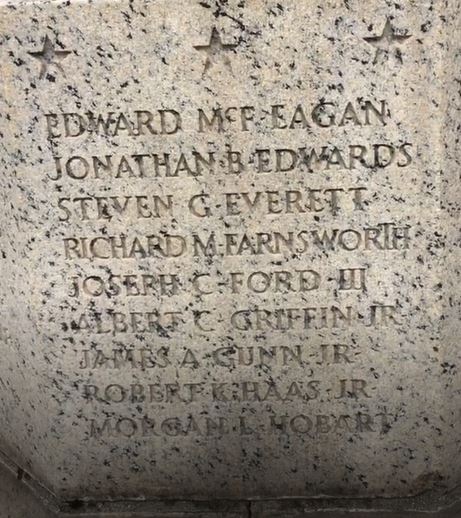
Deerfield Academy WWII Memorial, Deerfield, MA


These photos were taken as part of the Honor Roll Project. Click here to see other transcriptions by other volunteers.

The base of the flag pole reads, "In Memory of the Deerfield Boys who were lost in World War II 1941-1945."


The names are listed alphabetically around the octagonal granite base.


Richard T. Angell, Lawrence G. Bagg, Richard T. Bagg, Edward P. Barrows, Stephen H. Barton, John R. Baumann, Jr., John G. Brackett, Jr., Thomas D. Brophy, Jr., James S. Campbell II.


William J. Carroll, Neman B. Chase, Guy G. Clark, Jr., Arthur W. Clothier, William G. Conant, Nelson C. Dale, Jr., Bayard Dodge, Jr., John H. Dudley.


Edward McF. Eagan, Jonathan B. Edwards, Steven G. Everett, Richard M. Farnsworth, Joseph C. Ford III, Albert C. Griffin, Jr., James A. Gunn, Jr., Robert K. Haas, Jr., Morgan L. Hobart.


Paul H. Hyde, Jr., Allan J. Johnson, Thomas W. Johnson, Ward T. Kane, Richard M. Kimball, Jr., Arthur B. Koontz, Jr., George A. Ladd, Peter G. Lehman, George P. McNeal 3rd.


Wilson P. Novle, Donald W. Phillips, William S Pydych, William G. Ricker, Jr., Willard W. Roberts, Frank D. Rugg, Jr., John B. Bugg, George S. Cyr, A. Holton Sayce.


David A. Scott, H. Donald Seller, Howard C. Sheperd, Jr., Wilfrid L. Simmons, Mas Solomon, Alan W. Steadman, Henry B. Stimson, Jr.


Anderson Storey
George R. Strobridge, Edward E. Vanzile, Jr., Prentice C. Weathers, Joseph H. Webber, Morgan Wesson, Woodrow W. White, Benjamin Wilcox, Jr., Clarence C. Ziegler, Jr.

Heath, Massachusetts Veterans' Memorials


This post is part of the Honor Roll Project. Please visit here to see other transcriptions by volunteers in honor of our nation's veterans. The memorials for Heath's veterans are arranged on the common in the center of town. These photos were taken in November of 2018.


The central stone carries a 2017 dedication to veterans of all wars.


The plate affixed to a rough stone has the names of those who served in the early wars.


Revolutionary War
Charlemont Hill/South Heath
1775-1783

John Brown              Perley Hunt                    Solomon Temple    
William Brown         Benjamin Maxwell        Jonathan Thayer             
Francis Buck             Hugh Maxwell               Silas Thayer        
John Buck                 Reuben Rugg                  Silas Thompson  
William Buck            Edward Skinner             Josiah Warfield      
James Butler             Ashel Thayer                  Asaph White
Nathaniel Corbett    Dependence Thayer      Benjamin White
Joel Davidson           Jonah Thayer                 Luke White
Josiah Davidson       Salmon Temple
Valentine Harris       Seth Temple 

War of 1812
1812-1815

Amos Brooks                             David Snow                       
Abijah Gleason                          Benjamin Temple
Eli Gould                                     John Temple
Clement Porter                          Solomon Temple

Civil War
18161-1865

Henry D Barber               Charles Hamilton            Henry Rushmmore
Lemuel Bolton                 Thomas F. Harrington    William N. Sessions
William H. Bolton           Timothy M. Harrington  Elmer W. Spencer
Martin O. Brown             John L. Harris                  Herman A. Spooner         
Frederick N. Burton       Arthur W. Hall                  Edwin Sumner
Aaron Cady                       Almon Hawkes                Abraham Tanner
Nathan Chaffin                Wesley Hawkes                Amos Temple 
Patrick Connelly              John L. Hawks                 Henry H. Temple       
Lysander D. Estee           Henry B. Kinsman          William H. Temple
Edwin Fairbanks             Moses Lancaster              Aaron Trask
Luzern Fairbanks            Algernon Mandell           Horace A. Tyrerell
Adoniram J. Gleason      John Palmer                    John H. Underwood
Edward H. Gleason         Elisha Porter                    Sanford Underwood
Samuel K. Gleason          Charles F. Powers           Flavil Woodward
Thomas S. Gleason         Richard Powers
Samuel S. Gould              Charles H. Robbins

                        Spanish American War 1898

Alonzo Caswell       Fred Peon       Michael Smith       Walter Tole


The next carries the names of veterans from the two World Wars:

World War I 1917-1918

Louis Lively                     George W. Newton
Henry Lively                    Andreas E. Royer

World War II 1941-1945

David P. Beighley                       Emile T. Giard               Cleon J. Peters
Frank S. Brown                          Joseph L. Giard              Ernest H. Royer
Alton W. Churchill                    James J. Halfpenny       Louis E. Rundo
Harlow W. Churchill                 Patrick J. Halfpenny     Frederick A. Smith
Harold R. Churchill                   Henry M. Jenkins          Marshall E. Smith
Robert F. Coates                         Austin A. Leise               Richard H. Tanner  
Kenneth W. Crowningshield    John J. Leise                  Richard E.Thompson
Leonard J. Decota                      Armand M. Lively          Victor Vreeland
David J. Giard                             Bernard R. Lively           Frank D. Winters
David A. Giard                            Douglas M. Packard

The last plaque updates the WWII names and adds others who have served in more recent conflicts, including women, for the first time.


World War II (additional)


Harlow Churchill                  William Greene                  Alton Dewitt Ryan
Beatrice Nada Corey             Ada Mae Landstrom 

Korean War 1950-1953

Paul Begley                                  Russell Hillman               Thomas Sheridan
Craig Chattin                               Francis Jarrabeck            George A. Stetson
Donald H. Crowningshield       Edwin Lively                    Herbert S. Stetson
Richard Crowningshield           Maurice J. Lively             Gilbert Wilson
David J. Giard                             John MacDonald 
James R. Giard                            Bruce Patterson
John Giard                                   Frederick Russell

Vietnam War 1964-1973

Wendell T. Brown                      Alvin M. Hillman            Raymond F. Rice
Ralph E. Churchill                     Francis R. Kinsman        David F. Richardson
Arthur W. Crowningshield      Hormidas A. Lively         Leland Sherman
William E. Crowningshield     Michael T. Lively             Peter G. Smith
Richard E. Cutter                      Kris Matyas                       Roy C. Smith
Edwin H. Decker                       Fred H. Pazmino              Charles Stetson
Raymond J. Galipo                   Michael W. Rainville       Neil Stetson
                                                                                                   Robert Tanner

Veterans of Conflicts Since Vietnam

Panama 1989-1990 * Desert Storm 1991 * Bosnia 1992-1996 * Afghanistan 2001-2014

Daniel Borke            Sean P. Rabbitt                  Michael Smith
Ian Gallup                 Andrew Saunders             Joseph E. Thane
Fred Law                   Keith Sherman                  Lara R. Thane
Corey Lopes              Eli M. Smith

Veterans Serving Between Conflicts

Earle Crowningshield                 Raymond Giard            Felix Lively
Francis W. Crowningshield       Richard Giard               Levi Lively
Donald Giard                                Alexander Lively          Malvin Lively

Sunday, August 12, 2018

Nicaragua 1988, part 2


The Witness for Peace travelers began to see a little of the city of Managua on their first day on the ground. I found that a group of Benedictine Monks also chronicled a similar trip in 1988. A photo on this site, unidentified for location, looks like the "violent murals" that my mother refers to in her notes. This is what she said about that Sunday:

Sunday a.m.
Up early and no water. A man brought me a can full and a plastic bowl, my shower for today.

General orientation with Don:
  •        Buddy system, I am paired with Kate Adams
  •        Clayton and I to do daily health checks
  •        Ask to take pictures of people
  •        Shake hands, hello and good by
  •        Water is ok in Managua
  •        Water is off here on Monday and Thursday about 5 a.m. to 9 p.m. from two tanks, may get some
  •        Carry passport and yellow paper visa at all times

Breakfast of rice, two fried eggs, hot bread, and mango juice. Off to the Cardinal’s church. Bad streets, houses have open doors but barred windows, loud music, abject poverty to our eyes.

The cathedral was destroyed in the earthquake of ’72. This church is used by the Cardinal (Abano). He did not say this Mass. Church was nearly filled, all doors wide open. The music was surprisingly up-beat, a structured liturgy with communion on the tongue. The sermon was on the Gospel, but somewhat political with applause at the end, anti-government (so say those who understood.) It was a medium sized church, not at all ornate.

Lunch at a restaurant, then a city tour. No real sense of “city,” very spread out, many shells from the earthquake, grassy spots then normal looking buildings. None are very tall, only two hotels and a bank are.Videotaped by a TV crew on us TV added to push to get rid of Samoza. Huge statue of a peasant/soldier, gun in one hand and ? in other. Children’s park, a memorial for 12 year old boy martyr. Many families in the park, food vendors, rides. We walked through to the Grand Plaza. National on one side, Cathedral, memorials, graves of ?, eternal flame. Also a Buddhist monk from Japan on a 40 day fast in solidarity with the Nicaraguan people and in memory of Hiroshima/Nagasaki, begun on August 6th. When it began to rain he covered his shrine and continued to sit there.

Then we went to a new church for the 5:30 Mass. Music was quieter than I expected. Church is almost round, with violent murals, people coming and going, crowded. Again the homily was on the reading and the priest was applauded but his reflection was different, then two women and a man spoke. At the offertory the congregation went to the altar with their contributions. We sang “We Shall Overcome” and the “Battle Hymn of the Republic.” Back to the hotel after for supper of chicken, rice, and beans with yucca, tomato, coleslaw salad and a fruit drink.

Reflection turned into a wrangle over the man we took from the cathedral to Mass and sent home in a taxi.

Last night was punctuated by a thunder storm, then the roosters. Another long day.

Friday, August 10, 2018

Nicaragua, An Experience Like No Other


This is more introspective than most of my posts that deal with the more distant past. I grew up in a small town where my parents associated with like-minded people and supported anti-war causes during the Vietnam War. Dad ran for U.S. Congress in 1970 against a long time “hawk” in a conservative, rural district and was defeated soundly. We followed the Watergate hearings on our small, black and white TV during the summer of 1973 and cheered when Nixon resigned. 

My mother enjoyed being socially conscious. She demonstrated for peace at a nearby air base. A letter to the New York Times that was printed in the Sunday Magazine was one of her greatest achievements. When she traveled to Nicaragua with Witness for Peace from August 20th to 29th, 1988 she was 64. She wrote a diary that I read now with my own 60-year-old eyes. We are in strange times these 30 years later. How will I, how will each of us, make a difference?

Brief background: Daniel Ortega was President of Nicaragua in 1988, leader of the Sandinista National Liberation Front which had successfully overthrow the dictatorial Somoza government. While supplying economic aid to Ortega’s government, the U.S. under Regan continued to back the opposition right-wing Contras in the continuing civil war. Daniel Ortega was reelected in 2006 and rules today. The more things change, the more they stay the same. The Level 3 advisory issued 6 July 2018 by the U.S. State Department lists crime, civil unrest and limited health care availability as significant deterrents to travel. Non-emergency U.S. government personnel have been brought home. My son wisely decided against crossing into Nicaragua this summer as he toured nearby countries.

These are the words of Betty Simmons as she entered this war zone as a Witness for Peace:

This was an experience like no other. I answered a notice in the Sun in May. Went to a planning meeting in June where I met many of my fellow travelers. It seemed like a real mixed group: two Syracuse University students, a language teacher, a photographer, a Maryknoll priest and a nun, a social service worker, two retired men, a Witness for Peace young man; one or two who plan to go were not able to attend. We hope for 16.

Joe is supportive; Hugh thinks I am insane; representative of reactions. Solidarity from true friends. 

July and August, time for preparation: shots, ordering medications, thinking of what to pack and what not to pack. Collected antibiotics, soap, pens, etc. to leave there. Many well wishes, calls, just before time to leave.

Final meeting at Larry Tetler’s in Fayetteville on Friday night. Joe took me. Proud to have two carry-on sized bags and my small backpack. We talked of money – I am to carry ¼ of our funds for Nicaragua. We labeled a number of cartons: dental, medical, and school supplies.

The participants:

Sharon Souva
Sr. Chris Slomiliski
Barb deFrancqueville
Bonnie Windfield
Kate Adams
Mary Sopchak
Sophie Oldfield
Dennis Nett
Rev. Ted Sizing
George Burton
Ben Tupper
Clayton Koontz
Peter Wirth
Larry Tetler
Sim Doherty
Jack Pelletier
and me!

August 20
Overnight with Clayton. Fitful sleep. Good hot shower. Coffee and fresh peaches for breakfast. His wife drove us to the airport where (all but Sophie) met. Boxes checked through. Off at 7:00 with a stop in Cleveland and long wait in Miami. On to Honduras. Two stops for fuel. Then at Tegucigalpa to change planes. Can see many U.S. helicopters and planes and many armed soldiers at the airport, a duty-free shop, a woman selling drinks from a make-shift bar and sitting on a carton. In less than an hour aboard our second TAM-Sasa flight for about ½ hour flight to Managua. Too dark to see much of anything. Took quite a while to change our money ($60 each, 380 c. to $1) and get our yellow visa. We all adopted a woman and her baby (months old) coming from Miami to visit her family in Managua. No soldiers here!

We were met by Michelle, a long-term Witness for Peace, and Don Reasoner, Center for International Dialogue. Our bus is far from new. The owner and a driver go with it. Off to our hotel Colibri. Bonnie, Mary, Sophie and I volunteer to sleep next door. Introduction to the third world: dim light, people at a table near the entry, clothing drying, shower and latrine, stationary tubs. Down the hall to our room: four cots, no window, very warm (like Hong Kong). It was a long, long day. Paper thin walls: two young men talking over their evening.

Friday, July 6, 2018

Transcription, Handwriting and a Queen


Compiling the list of the Galveston 1900 Storm dead by GTHC has been a herculean task that continues to this day. It is understandable that inconsistencies persist. Several individuals with the surname Terrell are found on the on-line list: "Mrs. M.E.," "Queen age 33," and "Mrs. Q.V." with four children, all African American.

The entry for this family in the 1900 census in Galveston has been indexed incorrectly, but close reading of the names reveals their identities. The Terrells are indexed at Ancestry as Manny and Susan Terrall. At first look, it could be "Maurice."


Cross-referencing with the 1899 City Directory, we see that Manny is Morris E. Terrell, pastor of St. Luke's Missionary Baptist church at 1510 15th Street. This corresponds with the location of the family shown on the census. 


St. Luke's Missionary Baptist Church is still active in Galveston. The "history" portion of their web site at www.slmbc-gi.org reveals that this church was established in 1894 by 36 members of the Union Baptist church located at 11th and K. They name Rev. E.M. Terrell as their second pastor. The early church is described: These faithful members saved nickels, pennies and dimes to purchase property where they could assemble together for worship. Over a period of time, a lot and two buildings were purchased at 15th Avenue and Avenue N. One building served as the house of worship; the other was used as the parsonage. In 1900, a storm destroyed both buildings. 

The marriage of M.E. Terrell and Queen Alexander took place in 1890 in Waller, Texas, northwest of Houston. This corresponds with the births of the children listed in the 1900 census, born between 1892 and 1898. If the pattern of births every two years continued, Queen may have been pregnant when the storm hit.


Although "Susan" may be a more common name and the transcriber can be forgiven for the error in identifying Queen, the origin of her name can be better understood by reviewing the 1870 census.


Philip and Harriet Alexander, living in Hempstead, Texas, named their daughter Queen Victoria during the reign of Victoria in Great Britain. Queen named her oldest daughter Beatrice, the name of Victoria's youngest child and companion after the death of Prince Albert. In 1880 the Alexander family was enumerated about 10 miles away in Waller. The name of Philip's second daughter, Proserpine, also had royal origins, being  a daughter of Zeus and Demeter in classic mythology. In 1880 she was enumerated simply as "P."

Morris E. Terrell can be found in Galveston's tax records in 1894 as paying his poll tax. No records in Morris' name are found after 1900, leading to the conclusion that it is not Mrs. but Mr. M.E. Terrell who should be in the list of storm dead, and that his wife was counted twice as Mrs. Q.V. and as Queen, age 33.


Sunday, June 10, 2018

Jennie Summers Livingston


In many cases, large families were lost as their homes washed away in the 1900 Storm in Galveston. However, a single line entry in the 1900 census at an address in the "danger zone" near the Gulf has another story to tell.

Jenny, or Jennie, Livingston was a widow at 26, and working as a music teacher in 1900. She lived in a rented home on Avenue T at 39th Street and had been employed consistently for the past 12 months. She had been married for 9 years, which corresponds with a marriage licence filed in Harris County by William G. Livingston on 27 October 1891. He swore that he was over 21 years of age, and that his bride, Jennie A. Summers was over 18.


In the 1891/2 City Directory for Galveston, William G. Livingston was listed as a fireman for the Gulf, Colorado & Santa Fe Railroad. His residence was at 3202 Avenue R, with a Frances E. Livingston, widow of Edward. These appear to be his parents, based on their entry in the 1880 census in Galveston. In 1893 William paid his $1.50 poll tax in Galveston. In 1895/6 he resided at 4308 Church Street and was again employed as a fireman at or by Santa Fe.

The 1896/7 directory lists Jennie A, widow of W.G. Livingston, living at the southeast corner of 40th Street at Avenue T. where she was still living when the 1899/1900 directory recorded her as a teacher at a private school. A listing in the Lakeview Cemetery in Galveston at Find-a-Grave has W.G. Livingston dying in 1895 at Alvin.

Although Jennie states that she had two children who were both living when the census was taken in 1900, they did not live in her household. Between her husband's death about 1895 and 1900 she must have found herself unable to care for her children. After five years of marriage she had to earn a living, which may not have been enough to provide for three. Her mother-in-law Frances, age 48, was supporting herself and her 17-year-old daughter by teaching as well.

Jennie's boys are likely the Livingston children listed in 1900 among the 43 "inmates" in the Galveston Orphans' Home at 21st and M. Willie was reported on the census to have been born in October of 1892, about a year after Jennie and William's marriage. Next in the listing is Stanley Livingston, born September of 1894. Although she must have been pained to place her sons in the care of others, this action saved their lives. The orphanage, now the Bryant Museum, was damaged in the hurricane of September 1900, but suffered no casualties. The children were moved to Houston during reconstruction, to the Buckner Baptist Children's Home.

Young Willie may have been living independently back in Galveston in 1910, when a William G. "Levingston," age 17, was boarding on 24th and H, and working as a laborer on a ship. There is a Stanley Livingston whose Baltimore WWI draft registration states that he was born in Galveston. At that time, he had a wife and child. Frances Livingston is on the list of the storm dead, but not her daughter, Frances. The younger Frances does not appear to be in Galveston in 1910, but if she survived, she may have married and changed her name by then. The rest of the Livingston legacy is as yet undiscovered.

Jennie's short life had its joys and sorrows. She deserves to be remembered.


Monday, May 28, 2018

Memorial Day 2018 - Wendell War Memorials


Wendell's war memorial sits on the old town common. Bronze plaques have been affixed to millstones as uniform monuments to the 20th century conflicts. I will check back in the future and see if the fourth stone will also hold names from the earlier wars. This transcription is part of The Honor Roll Project

The first plaque reads:

In Memory of Those Who Served in The World War from Wendell, Massachusetts

*Frank E. Richards
Edwin D. Austin
Clarence C. Begor
Frank Betters
Edith F. Bowen R.M.
Webster M Brown
John E. Burkhardt
George A. Cogswell
Frank H. Day
Marvin N. Ellis
Jesse L. Haskins
Gustoff A. Hook
Ralph L. Jennison
Arthur Parent
Carl J. Sandberg
Gustav L. Sandberg
Leon O. Taylor

Erected by Wendell Grange 1930
On the 150th Anniversary
Of the Incorporation of the Town

World War I Monument

In Memory of Those who Served in World War II From Wendell Massachusetts

*George H Gardner
* Calvin P. Merchant
Raymond E. Avery
Edward J. Bezio
Clayton J. Bezio
Leon Bezio
M. James Bowen
Kenneth W. Clarkk
Adam Drozdowski
Joseph Drozdowski
Robert E. Ellis
Andrew J. Fox
Myron A. Gibbs
Rubert V. Goddard
Avery H. Harrington
Eugene A. La Valle
Arthur B. Lewis, Jr.
Dale W. Lewis
Donald G. Lewis
Ralph E. Lewis
Ruth V. Lewis
Albert H. Hulholland
Merrill A. Noyes
Lewis E. Powling
Merle O. Powling
Clarence H. Pratt
Jesse W. Pratt
Charles F. Reed
John L. Van Rensselaer
Earl E. Sabot
Sherman W. Sadler
Roland L. Sears
Charles M. Wetherby
Francis E. Wetherby
Clarence O. Wetherby
Raymond C. Wirth

Erected by Town of Wendell and Grange

World War II Monument


In Memory of Those Who Served in the Korean and Vietnam Conflicts from Wendell, Massachusetts

Korea
Elmore Andrews
Richard Bezio
Edward Duhaime
Donald Ellis
Harry Lewis
Roy Sampson
Merrill Wetherby
Robert Ashley
Kenneth Clark
Theodore  Lewis
Edward Wirth
Stephen Clark
Richard Hurtle
John Peettit
William Starkey
Myron Bowen

Vietnam

Joseph Bagdonas
John Carey
Donald Cornwell
Gary Cornwell
David Hisdreth
Arthur Taylor
David Wilder
Leonard Wirth
Anthony Diemand
Joseph Diemand
Ray Chevalier
Edward Chase
Robert Durkee
Kenneth Wing, Jr.
Dennis Lewis

Erected by the Town of Wendell and Through the Generous Donation of Many Private Citizens


Friday, May 25, 2018

Allison Update - Good News


The Allison family of Galveston and New Orleans, profiled earlier, was not completely wiped out in the 1900 storm. The eldest son, Walter, survived!

Walter was born in December of 1881, according to the 1900 census of Galveston, recorded just a few weeks before the storm. At 18, he was employed as an apprentice machinist at a foundry. We can speculate that he was at his job when the storm began, and was prevented from returning to his home near the Gulf. Several iron works were listed in the city directories, the largest being Lee Iron Works, near the railroad station on the north side of the island. He may have been the informant that enumerated eight children of his parents among the storm dead, including his two uncles, Edward and Archie Reagan.

In 1910, Walter can be found still living in Galveston, in the household of Lewis Cook on Avenue F near 12th Street. He married Katie Beagor(?) soon after and had a daughter Ethel in 1911, and a son, Walter, jr. in 1914. Walter Allison died in San Antonio on 19 October 1918 of influenza at the peak of the epidemic there. The disease had spread very quickly through the city. and its Army installations. See more details here.

Walter was buried in the Lakeview Cemetery in Galveston, near the Gulf. His wife, Kate, returned to Galveston and remarried to Gustov Hoff, a German tailor. They moved to Washington, D.C. by 1930 where they had a shop. Ethel married and had a son whom she named Walter. Her brother, Walter, had married and was working for the Treasury Department, but had no children at the time of the 1940 census. Several more generations of Allison descendants could be alive today, far removed from the horrific storm of 1900.